
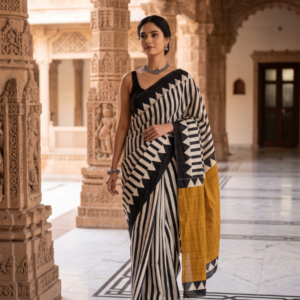
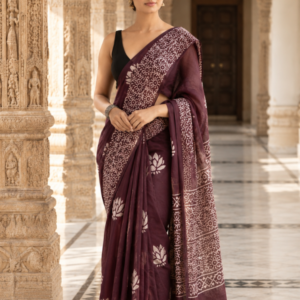
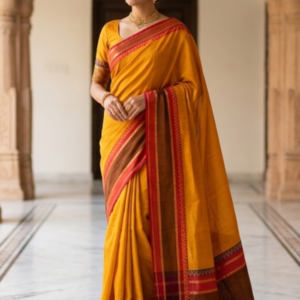
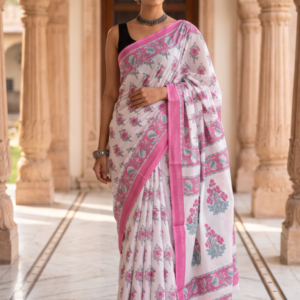
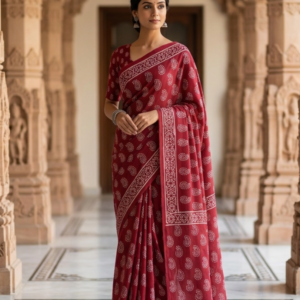
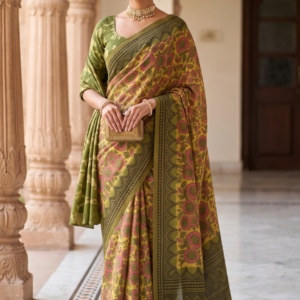
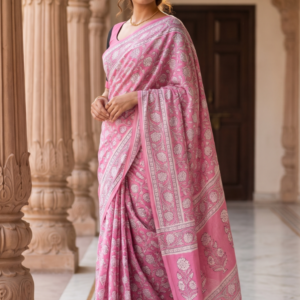
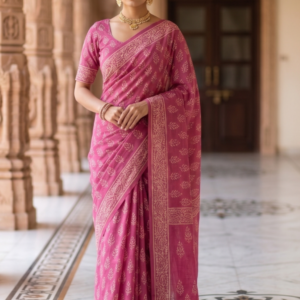
Have you ever looked at a saree and wondered how much history could possibly be woven into a few metres of fabric?
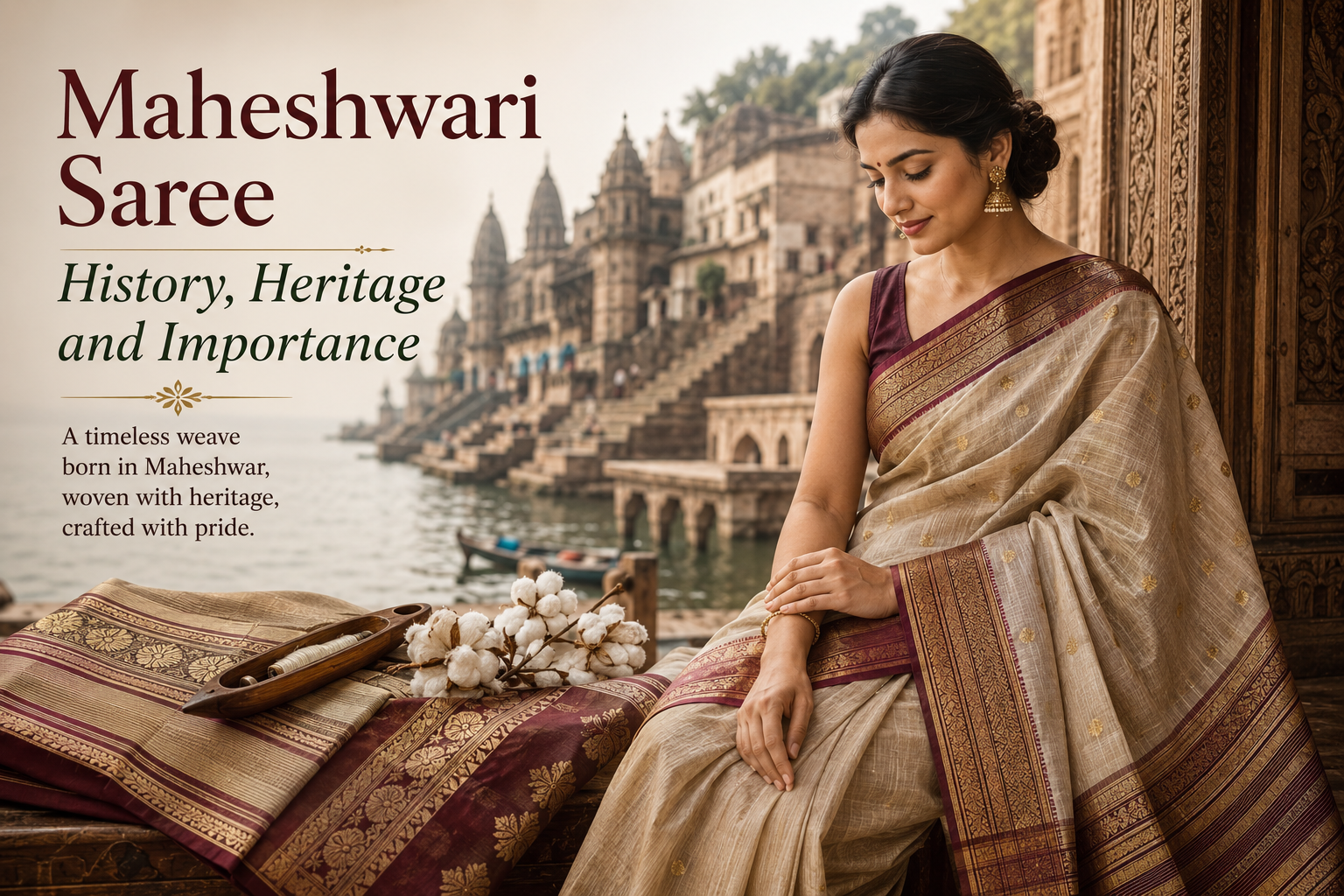
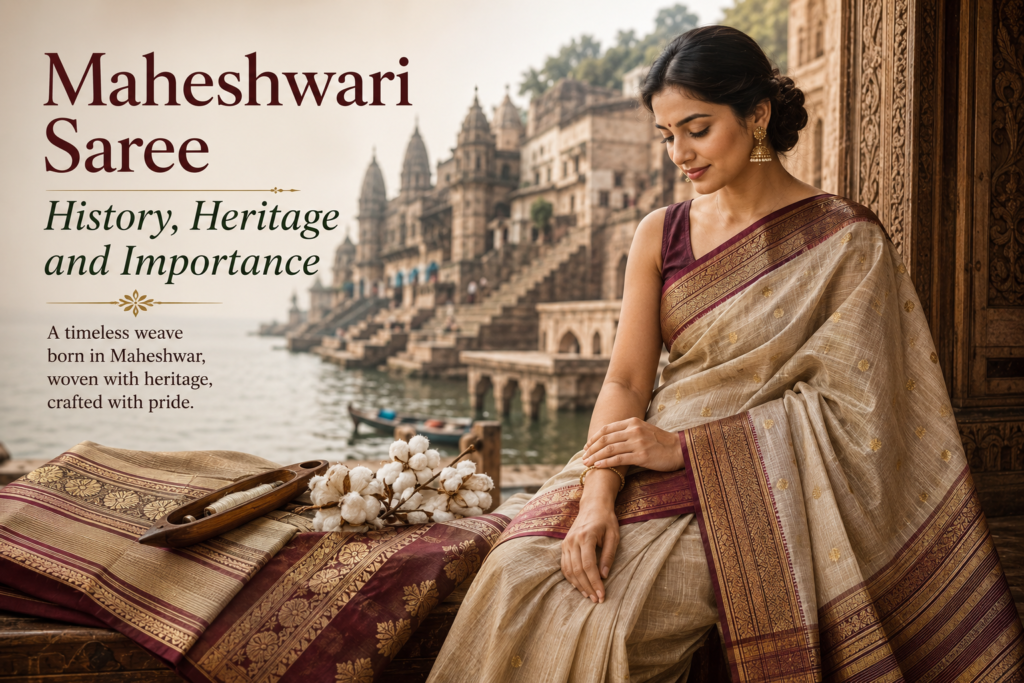
The Maheshwari saree is one of those textiles that makes you pause and appreciate the story behind what you are wearing. Elegant, lightweight, graceful, and deeply connected to the royal heritage of Madhya Pradesh, the Maheshwari saree is much more than a beautiful Indian garment.
Its story takes us to the historic town of Maheshwar, to the banks of the Narmada River, and to one of India’s most admired women rulers, Ahilyabai Holkar.
So, how did the Maheshwari saree come into existence? Why is it considered such an important part of Indian handloom heritage? And what makes this saree so special even today?
Let’s discover its story together.
What Is a Maheshwari Saree?
A Maheshwari saree is a traditional handwoven saree associated with Maheshwar in Madhya Pradesh, India.
Known for its delicate texture, elegant borders, subtle patterns, and beautiful combination of silk and cotton, the Maheshwari saree has a distinctive character of its own.
Depending on the weave, Maheshwari sarees can be made using cotton, silk, or a combination of both. This gives them a wonderful balance between lightness, comfort, and a refined sheen.
Perhaps that is why a Maheshwari saree can feel equally appropriate for a quiet day, a festive celebration, a cultural occasion, or an elegant evening gathering.
It doesn’t need to be heavily embellished to make an impression.
Its beauty comes from the weave itself.
The Royal History of the Maheshwari Saree
To understand the history of the Maheshwari saree, we need to travel back to the eighteenth century.
The story is closely associated with Maharani Ahilyabai Holkar, the celebrated ruler of the Malwa region.
Ahilyabai Holkar made Maheshwar an important centre of culture, architecture, and craftsmanship during her reign. She is remembered not only for her administrative abilities and contributions to temple restoration but also for encouraging artisans and traditional crafts.
According to widely told accounts of Maheshwari weaving history, Ahilyabai Holkar invited skilled weavers from other parts of India to Maheshwar and encouraged them to establish their craft there.
The intention was to create a distinctive textile tradition that could become associated with the royal court and the city itself.
Over time, weaving became deeply connected with Maheshwar.
And from this royal association emerged the saree tradition that we now know as the Maheshwari saree.
Ahilyabai Holkar and the Maheshwari Weaving Tradition
When we talk about Maheshwari sarees, it is almost impossible not to talk about Ahilyabai Holkar.
Her contribution gives this textile a particularly fascinating story.
Ahilyabai was known for her patronage of art, architecture, religion, and craftsmanship. By supporting skilled artisans, she helped create an environment where traditional crafts could flourish.
The weavers who settled in Maheshwar brought their knowledge and techniques with them. Over generations, those skills interacted with local influences and gradually developed into the distinctive Maheshwari weaving style.
This is what makes the saree more than a piece of fabric.
It represents the relationship between a ruler, a city, its artisans, and a living craft tradition.
Why Maheshwar Became Important to Weaving
Have you ever wondered why a particular place becomes famous for a particular craft?
Often, geography and history have a lot to do with it.
Maheshwar sits along the Narmada River and has a long history as a cultural and religious centre. The town’s historic temples, ghats, palace, and riverside setting created a distinctive cultural environment.
The development of weaving added another important layer to the identity of the city.
Over time, Maheshwar became closely associated with handloom textiles, and the saree itself became an expression of the town’s heritage.
Today, when you hear the name Maheshwari saree, you are immediately taken to the historic landscape of Maheshwar.
That connection between place and textile is one of the most beautiful aspects of Indian handloom traditions.
What Makes a Maheshwari Saree Special?
So, what should you look for when you see a Maheshwari saree?
The first thing you may notice is its elegant simplicity.
Maheshwari sarees are generally known for their lightweight fabric, graceful drape, distinctive borders, and refined patterns.
The combination of silk and cotton can give the saree a soft feel with a subtle lustre, while pure cotton versions offer an especially comfortable and breathable experience.
The borders are particularly important.
Many traditional Maheshwari sarees feature contrasting or complementary borders that give the fabric its unmistakable character.
Some designs also feature striped or checked patterns, while traditional motifs add another layer of visual interest.
The overall effect is sophisticated without being excessive.
The Famous Maheshwari Borders
If you have ever seen a Maheshwari saree closely, you may have noticed how much attention is given to the border.
The border isn’t simply a decorative strip added to the saree.
It is an important part of the design identity.
Traditional Maheshwari sarees are known for their distinctive borders, often incorporating geometric patterns and motifs inspired by the architectural and cultural surroundings of Maheshwar.
The border can create a beautiful contrast against the body of the saree and gives the garment its structured appearance.
It is one of those details that may seem simple at first but becomes more fascinating the longer you look at it.
Maheshwari Saree Motifs and Designs
Traditional Maheshwari weaving includes a variety of patterns inspired by nature, architecture, and local culture.
Some motifs are associated with the Narmada River, while others draw inspiration from architectural elements and traditional Indian design.
Geometric patterns, stripes, checks, floral-inspired elements, and decorative borders can all be seen across different Maheshwari saree designs.
The famous architectural inspiration associated with the sarees is especially interesting because Maheshwar itself is filled with historic structures.
The town’s temples, palace architecture, and riverside ghats provide a visual language that has influenced the textile tradition.
In this way, the saree becomes almost like a miniature piece of the city.
The Influence of the Narmada River
The Narmada River is an important part of Maheshwar’s identity.
Flowing beside the historic town, the river has shaped its cultural and spiritual life for centuries.
It is therefore natural that the river and its movement have influenced local artistic traditions.
Some Maheshwari designs are associated with flowing or wave-like patterns that evoke the movement of the Narmada.
There is something poetic about this connection.
The same river that has been part of Maheshwar’s daily and spiritual life also becomes part of the visual language of its textiles.
When you wear a Maheshwari saree, you are therefore carrying a small part of the landscape with you.
The Craftsmanship Behind Every Maheshwari Saree
A beautiful saree can sometimes make us forget how much work goes into creating it.
Before a Maheshwari saree reaches you, the weaver has already spent considerable time preparing and working with the yarn.
The warp and weft need to be carefully arranged on the loom. Colours have to be coordinated, patterns need to be formed accurately, and the border has to be woven with precision.
The result is created through patience.
This is the quiet beauty of handloom.
There is a person behind the fabric.
There is skill behind the pattern.
And there are generations of knowledge behind the technique.
That human connection is one of the reasons handwoven Maheshwari sarees feel so special.
Why Maheshwari Sarees Are Known for Their Lightweight Feel
One of the reasons women love Maheshwari sarees is their comfortable drape.
Traditional Maheshwari weaving developed into a textile that could be elegant without becoming unnecessarily heavy.
Silk and cotton combinations can create a beautiful balance between softness, lightness, and subtle shine.
This makes the saree especially versatile.
You can wear it for a long day without feeling overwhelmed by the fabric, yet it still has enough elegance for a special occasion.
It is a wonderful example of how Indian textile traditions often combine beauty with practicality.
The Importance of Maheshwari Sarees in Indian Handloom Heritage
So why does the Maheshwari saree matter beyond fashion?
Because it represents a living craft tradition.
India’s handloom heritage is made up of countless regional weaving traditions, each with its own history, techniques, patterns, and cultural identity.
The Maheshwari saree is an important part of that heritage.
It preserves knowledge that has been passed down through generations of weavers.
It also keeps the history of Maheshwar visible.
When people continue to wear and appreciate Maheshwari sarees, the story of the craft continues to be told.
And that is incredibly important in a world where traditional crafts can easily disappear when there is no longer enough demand for them.
Maheshwari Sarees and the Importance of Supporting Weavers
When you purchase a handloom saree, you are not simply choosing an outfit.
You are supporting a craft ecosystem.
Weaving communities depend on the continued appreciation and demand for their work. When traditional textiles remain relevant in modern wardrobes, artisans have greater opportunities to continue their craft.
This is particularly meaningful with heritage textiles.
A Maheshwari saree represents not only the finished product but also the knowledge, labour, and creativity of the people who made it.
Every purchase can therefore become a small way of helping keep traditional craftsmanship alive.
Maheshwari Sarees in Modern Fashion
You might be thinking, “A saree with such a long history sounds beautiful, but can I actually wear it with a modern wardrobe?”
Absolutely.
This is where the Maheshwari saree becomes especially interesting.
Its clean patterns and lightweight texture make it incredibly adaptable.
You can wear it with a traditional blouse for a classic Indian look. You can also pair it with a contemporary blouse, minimalist jewellery, a structured handbag, or modern footwear.
The same saree can look completely different depending on how you style it.
And isn’t that the best kind of fashion?
Something that respects tradition while giving you the freedom to express your own personality.
Maheshwari Sarees for Everyday Elegance
Not every saree needs to be reserved for weddings and festivals.
A lightweight Maheshwari saree can be a beautiful choice for everyday elegance.
Imagine wearing a soft cotton Maheshwari saree to work with a simple blouse and understated jewellery.
Or imagine wearing a silk-cotton Maheshwari saree for a family gathering with traditional earrings and a neatly styled bun.
The possibilities are endless.
The saree adapts to your lifestyle rather than demanding that you change yourself for it.
Maheshwari Sarees and Sustainable Fashion
There is another reason traditional handloom sarees are becoming increasingly relevant today: conscious fashion.
Fashion consumers are becoming more interested in clothing that has longevity and meaning.
A handwoven saree can remain in your wardrobe for years and can be styled in many different ways.
Instead of being tied to one particular fashion season, a Maheshwari saree can continue to look relevant because its appeal comes from craftsmanship rather than short-lived trends.
This makes it a natural fit for a more thoughtful approach to fashion.
Buy less.
Choose well.
Wear often.
And appreciate the story behind what you own.
The Cultural Importance of Maheshwari Sarees
A saree can represent much more than regional craftsmanship.
It can represent identity.
It can represent family.
It can represent a place.
And sometimes, it can represent an entire chapter of someone’s life.
Maheshwari sarees carry the identity of Maheshwar with them.
The town, the Narmada, the royal history of Ahilyabai Holkar, and the generations of artisans who contributed to the craft are all part of the story.
This cultural connection is what makes heritage textiles so valuable.
They allow us to carry history into the present.
How Maheshwari Sarees Connect Generations
Think about the sarees that women in your family have worn.
Perhaps you remember your grandmother wearing a traditional saree during festivals. Maybe your mother has a favourite handloom saree that she still treasures.
This is how textiles become family memories.
A Maheshwari saree can follow the same journey.
It can be purchased today, worn for an important occasion, carefully preserved, and eventually passed on to another generation.
The saree changes hands, but its story continues.
That is one of the greatest strengths of Indian handloom traditions.
The Future of the Maheshwari Saree
The future of the Maheshwari saree depends on balancing heritage with innovation.
Traditional techniques can remain at the heart of the craft while designers and weavers experiment with new colours, patterns, textures, and styling possibilities.
Younger women may wear Maheshwari sarees with contemporary blouses.
They may choose minimalist designs rather than heavily traditional ones.
They may wear them to offices, exhibitions, dinners, cultural events, or casual gatherings.
None of this takes away from the heritage of the saree.
Instead, it gives the tradition a new life.
A craft survives when people continue to use it.
And a saree remains relevant when every generation finds its own reason to wear it.
Why You Should Consider a Maheshwari Saree for Your Wardrobe
If you are looking for a saree that feels elegant, lightweight, versatile, and rich in history, the Maheshwari saree deserves a place on your list.
It offers the beauty of traditional Indian handloom without feeling overly elaborate.
It can be styled traditionally or contemporarily.
It can work for everyday elegance as well as special occasions.
And most importantly, it allows you to wear a piece of India’s textile heritage.
When you choose a Maheshwari saree, you are not simply choosing a colour or pattern.
You are choosing a story.
Final Thoughts: More Than Just a Handloom Saree
The history of the Maheshwari saree is a story of royalty, craftsmanship, geography, culture, and generations of skilled artisans.
From the historic town of Maheshwar to the banks of the Narmada, from the patronage of Ahilyabai Holkar to the hands of today’s weavers, this saree carries a remarkable journey within its weave.
And perhaps that is why the Maheshwari saree continues to feel timeless.
Fashion may change.
Colours may change.
Styling may change.
But the beauty of craftsmanship remains.
So, the next time you drape a Maheshwari saree, take a moment to look beyond the fabric.
Think about the weaver.
Think about Maheshwar.
Think about the Narmada flowing beside the historic town.
Think about the royal heritage that helped shape this tradition.
And remember that you are not simply wearing a saree.
You are wearing a piece of Indian history that continues to live, evolve, and tell its story through every thread.

No Comment Found.